Desiccant Dryer Energy-Saving Retrofits & Diagnostics
Desiccant Dryer Energy Saving Retrofit & Diagnostics
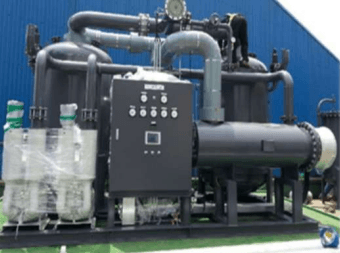
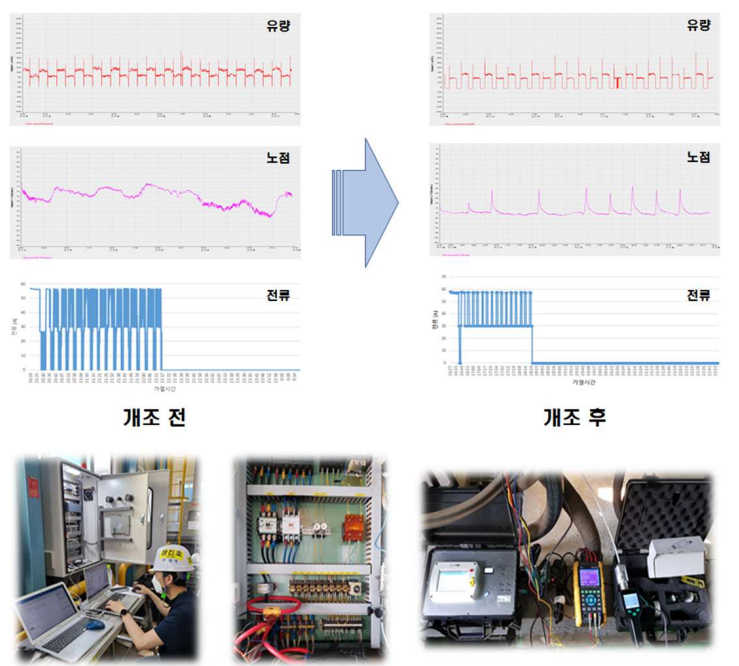
A retrofit service that lowers the operating cost of your existing desiccant dryer without replacing it, by improving its controls and circuits. We apply patented technologies such as balanced-load flow control, closed-loop circuits and regeneration time control, and verify the improvement by measuring flow, dew point and current on site.
How to cut operating costs without replacing the equipment
A desiccant dryer consumes most of its energy in the regeneration process. GENEQ provides retrofits and consulting that lower operating costs by improving the control logic and process circuits of your existing equipment rather than replacing it. On site we measure flow, dew point and current to compare and verify performance before and after the retrofit.
1. Balanced-load flow control
Item | Description |
|---|---|
Conventional | Stage 1: timed operation → Stage 2: timed + dew point operation |
Improved | Stage 3: timed + dew point + balanced-flow operation / balanced-load control across multiple dryers |
Configuration and features | Two-channel dew point meter · flow meter and control valve at the inlet · smart control for maximum cycle extension |
Patent | No. 10-2265756 |
2. Closed-loop process circuit
Item | Description |
|---|---|
Conventional | Open circuit for both the regeneration heating and cooling steps |
Improved | Regeneration heating and cooling steps in a closed circuit |
Features | Lower heater power · lower blower static pressure loss · fewer blower and heater component failures |
Patent | No. 10-2265745 |
3. Regeneration time control
Item | Description |
|---|---|
Conventional | Regeneration heating 2.5 hr and cooling 1.5 hr, fixed by timer |
Improved | Regeneration heating ends when the lower tower temperature reaches its setpoint, and cooling when the upper tower temperature does |
Features | RTD sensors at the top and bottom of each tower · real-time PLC temperature monitoring · optimal regeneration time control logic |
4. Improving inlet temperature: chilled water pre-cooler or refrigerated dryer
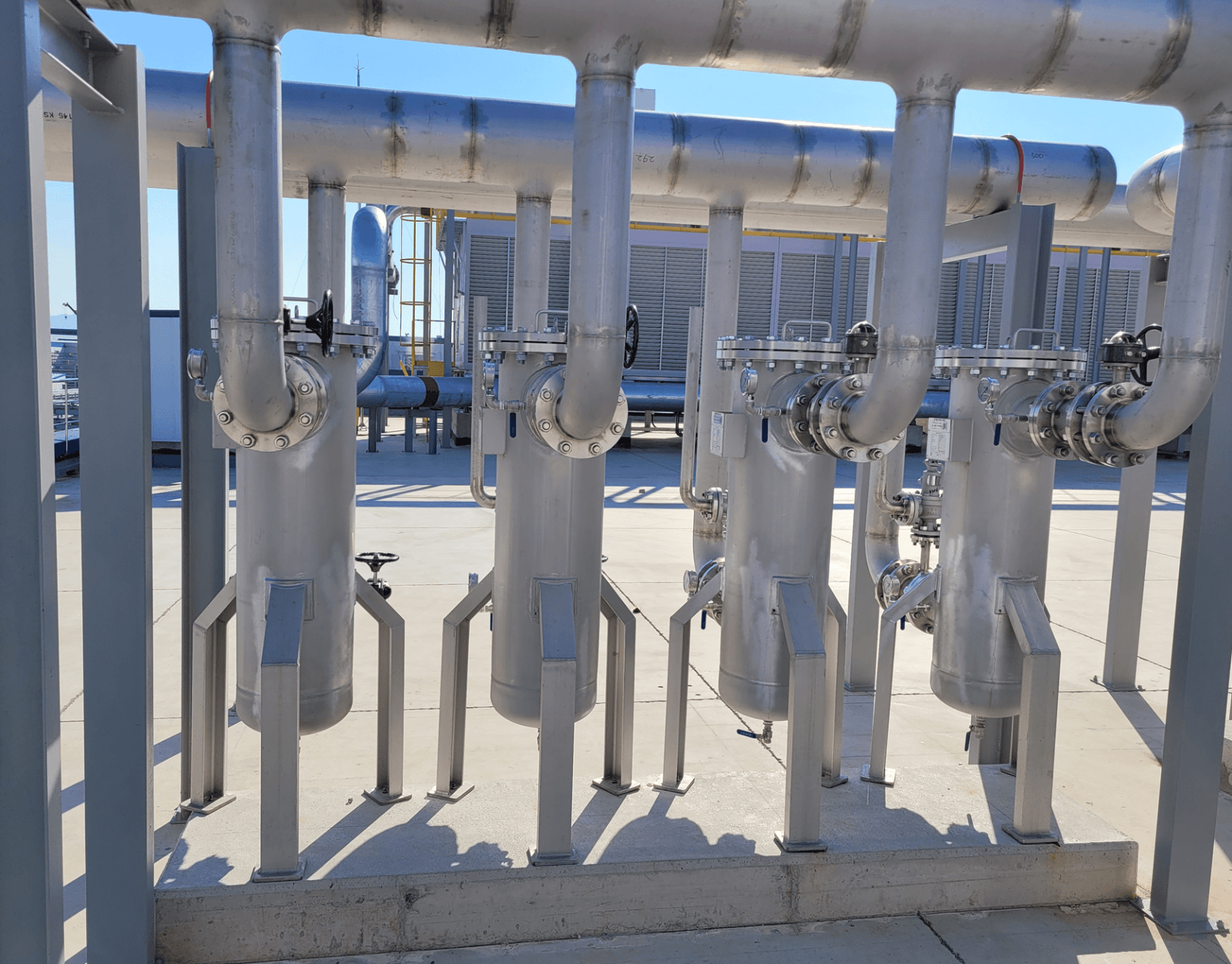
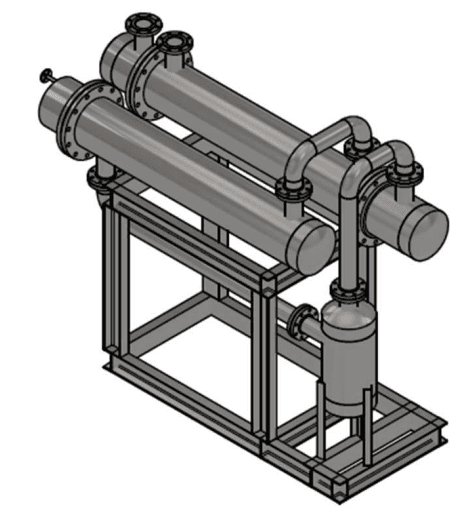
A desiccant adsorbs more moisture the lower the inlet temperature. Comparing 40 °C and 20 °C inlet, the adsorption capacity differs by up to 13% (at 7 barG, 100% RH). Placing a chilled water cooler or refrigerated dryer upstream reduces the load on the desiccant dryer, improving the dew point and cutting heater power.
Method | Considerations | Expected benefit |
|---|---|---|
Chilled water pre-cooler | Chilled water infrastructure available with spare capacity; chilled water cooler and reheater | Better desiccant dryer dew point · outlet temperature controllable via control valve |
Refrigerated pre-treatment | Where no chilled water infrastructure exists: direct-expansion or indirect type | Pressure dew point of 4–10 °C · lower heater power |
Dew point control | Refrigerated dryer or chilled water cooler installed upstream | Lower heater power cost · longer desiccant life |
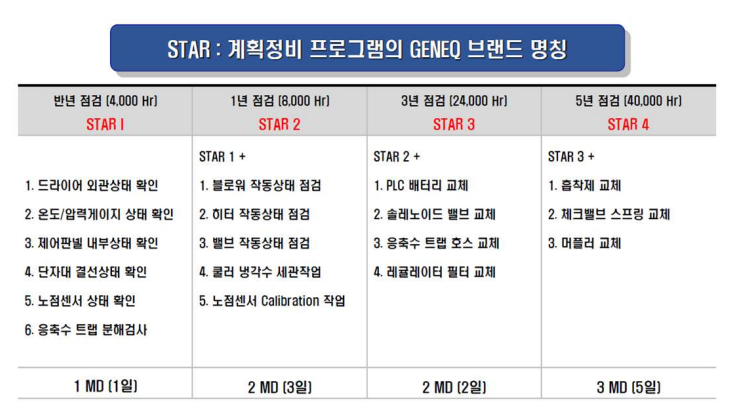
5. Planned maintenance program (STAR 1 to 4)
A dryer runs reliably only when time-based maintenance (TBM) and condition-based maintenance (CBM) are managed together. GENEQ operates a four-level planned maintenance program based on accumulated running hours.
Level | Interval | Main inspection and replacement items | Duration |
|---|---|---|---|
STAR 1 | 6 months (4,000 hr) | External condition, temperature and pressure gauges, control panel interior, terminal block wiring, dew point sensor condition, condensate trap disassembly and inspection | 1 man-day (1 day) |
STAR 2 | 1 year (8,000 hr) | STAR 1 + blower, heater and valve operation check, cooler water-side tube cleaning, dew point sensor calibration | 2 man-days (3 days) |
STAR 3 | 3 years (24,000 hr) | STAR 2 + replacement of PLC battery, solenoid valves, condensate trap hoses and regulator filters | 2 man-days (2 days) |
STAR 4 | 5 years (40,000 hr) | STAR 3 + replacement of desiccant, check valve springs and mufflers | 3 man-days (5 days) |
Diagnostics and retrofit inquiries
Just tell us the type, capacity and operating history of the dryer you are currently using, and we will first review the scope for improvement.
We propose the approach that fits your site, whether a purge-to-non-purge conversion, a control panel replacement or the introduction of dew point control.